Saturday, 1 December 2018

MAKE MORE AND MORE PROGRESS, ACCORDING TO GOD’S WILL

I SUNDAY OF ADVENT - Luke 21:25-28,34-36
Advent is always a time full of hope in which we look forward together with Mary to the coming of Jesus. This Sunday's readings present us with some basic attitudes which we should cultivate, especially during this Advent time.
In the Gospel, Jesus advises us to pay attention to what is happening about us. It is so easy to lead a distracted life, not paying attention to the signs that appear along the way, mainly the danger signs. We live as if everything is running smoothly. However, Jesus gives us a strong warning: we will pass through widespread situations of crisis, uncertainty and anguish that may lead us into despair, causing us to do acts of true madness. The world will feel threatened and people will be at a loss on how to deal with such menace, in such a way that there will be “men dying of fear”. In fact, humanity has faced catastrophe so many times that it got used to it until the day it will reach its climax. However, Jesus’ warning is not in order to instil fear, but in order to strengthen us and fill us with hope.
In the first reading, Jeremiah announces that there will be a time of “honesty and integrity in the land”. There will be a time for salvation when we “shall dwell in confidence” and peace. And city we will live in will be called “The Lord is our righteousness” (Jer 33:14-16). Such a time will be brought in by the Messiah, who will come to establish God’s Kingdom.
And Jesus speaks of the Son of Man “coming in a cloud with power and great glory” to establish his kingdom, a kingdom of justice and peace. He will come to put under his feet all the powers of evil. He will come as judge and Saviour. That will be a time of liberation, in which we will be filled with joy and pride because God our Father will grant us the inheritance promised to us as his children. Indeed, we can “stand erect” and hold our “heads high”, and we will join all the saints singing God’s praises.
Finally, Jesus advises us to “stay awake, praying at all times”. We will go through difficult times and on our own only we will not have “the strength to survive all that is going to happen, and to stand with confidence before the Son of Man.” It is so easy to go astray and so we must be on the watch, not allowing our hearts to “be coarsened with debauchery and drunkenness and the cares of life”. We may fall into a “trap”, accepting false values as the true ones and taking this passing world for the eternal.

In the second reading, Paul advises us to grow in holiness: “Finally, brothers, we urge you and appeal to you in the Lord Jesus to make more and more progress in the kind of life that you are meant to live: the life that God wants” (1 Tes 4:1). May the Lord grant us his grace, so that we grow more and more in love.

Saturday, 24 November 2018

TO HIM BE GLORY AND POWER FOREVER AND EVER

XXXIV SUNDAY IN ORDINARY TIME: CHRIST THE KING - John 18:33-37
We end the liturgical year with the celebration of the solemnity of Christ the King, in which we proclaim him as King of the Universe. And we may ask ourselves what does that mean? Throughout history, the experience of being under a king has not been always a happy experience. What kind of a king is Jesus? Most of the times, we associate kingship with dominion and oppression. Kings impose themselves impose themselves on people and are jealous of their authority and position. That’s why Jesus warned his disciples not to be like the rulers of the earth: “You know that those who are considered rulers of the Gentiles lord it over them, and their great ones exercise authority over them. But it shall not be so among you” (Mk 10:42-43). And proposing himself as the model for their leadership, Jesus told them: “the Son of Man came not to be served but to serve, and to give his life as a ransom for many” (Mk 10:45). In fact, Jesus never showed interest in political power and, when people tried to make him a king, he went into hiding. He did not come to be an earthly king and to impose himself on people, if necessary by force, as it had been the case with King Herod and with Emperor Augustus. Jesus’ kingship is of a completely different order and he makes it very clear to Pilate when he tells him: “My kingdom is not of this world” (Jn 18:36). And he explains it to the governor. He came into Jerusalem on a donkey, like the poor peasants. And he has no army to fight for him. He is completely at the mercy of those who have power. Nobody needs to be afraid of him, because he does not constitute a threat to anybody. Indeed, looking at history and at the presence of Christ in history, we may ask ourselves why is he perceived as a threat for the propagators of ideologies and the holders of power. Why so many of his disciples are being ostracised and persecuted? Christians have never been a threat to the State. 
To Pilate, Jesus explained his kingship: he came to be king of those who search for the truth and are only content with the truth.  In a similar manner, he had told the Jews: “If you abide in my word, you are truly my disciples, and you will know the truth, and the truth will set you free” (Jn 8:31-32). Freedom, justice and peace will be achieved only if we become pursuers of the truth.
It is easy to see that Pilate did not care about the truth,  as he did not wait for Jesus’ answer to his question on the truth and as he was ready to condemn Jesus on trumped-up charges. Ignoring and despising the truth, he was ready to commit an injustice condemning the guiltless and blameless Christ.
Jesus presented himself as king, only during his trial, when there was no possibility of being misunderstood. On top of his cross, they wrote: “Jesus of Nazareth, King of the Jews” (Jn 19:19), thus presenting the official reason for his condemnation. Such statement presents on one side Jesus’ claim that he is king and on the other side the false accusation that he is the king of the Jews.

The first reading taken from the book of Daniel and the second reading taken from the book of revelation helps us to understand the claim that Jesus is King of the Universe. He is that human being - the Son of man - on whom it “was conferred sovereignty, glory and kingship, and men of all peoples, nations and languages became his servants” (Dan 7:14) and he is “the First-Born from the dead, the Ruler of the kings of the earth” (Rev 1:5). He is human and divine and in him, humanity will find salvation, making of “us a line of kings, priests to serve his God and Father; to him, then, be glory and power forever and ever. Amen” (Rev 1:6).

Saturday, 17 November 2018

COME, LORD JESUS!

XXXIII SUNDAY IN ORDINARY TIME - Mark 13:24-32
Will the universe come to an end? If so, then when and how will it happen? To the first question, even scientists give an affirmative answer. As for the date and the manner of that event, the imagination goes wild. On that, Jesus was very clear to his disciples: “As for that day or hour, nobody knows it, neither the angels of heaven, nor the Son; no one but the Father” (Mk 13:32). So we should not waste our time involving ourselves in guessing possible dates for the end of the world. Those who do that end up as a laughing stock.
Jesus said that “the powers in the heavens will be shaken” and there will be “a time of anguish” (Dan 12:1) or a time of “tribulation” (Mk 13:24). However, the stress is put on the coming of the Son of Man (that is Jesus Christ), who will come full of power and glory to gather his people and deliver them. For the faithful disciples of Jesus Christ, the end of the world will not be a moment of horror and terror, but a great time of joy, as they become partakers of the glorious victory of Christ. With his coming, Jesus Christ will bring in the New World, a new creation, where there will be no suffering and no tears, but only the joyous cries of victory, because the powers of oppression and death have disappeared and God will reign supreme, being “all in all” (1 Co 15:28).
Jesus advises us to pay attention to the signs of the Lord’s proximity so that we are prepared to answer his call and to welcome his coming. If he surprises us and finds us unprepared, we will be left to our own fate, far from him with whom there are life and salvation.
Christians look forward to that time with eagerness, which is well expressed in a very simple prayer at the end to the book of Revelation: “Come, Lord Jesus!” (Rev 22:20).

With the Psalmist, we pray: “Preserve me, God, I take refuge in you” (Ps 16:1)

Saturday, 10 November 2018

THE LORD THWARTS THE PATH OF THE WICKED

XXXII SUNDAY IN ORDINARY TIME - Mark 12:38-44
In this Sunday’s liturgy, the widows come to the forefront. In the first reading, we hear about the widow who lived in the Phoenician city of Sarepta. She had a son, she was poor to the point of starving and she was a foreigner, living in Sarepta near Sidon. In spite of being a pagan, she welcomed Elijah and shared with him the last food she had, trusting in God’s promise conveyed to her by the prophet who had run away for his own safety from the unfaithful people of Israel. Jesus would use the example of the widow of Sarepta as an indictment against those who refused to believe him. The outsiders (the pagans) proved to be more willing to listen to the message of salvation than the members of the people of God. This remains as a warning to us. We should not be overconfident, taking God for granted and thinking that belonging to the Christian Church is enough guarantee of salvation.
In the Gospel, we are presented with another widow, who, in spite was extremely poor, offered to God everything she had, thus putting herself totally in God’s hands. Humanly speaking, her attitude looks like foolishness. How could she give the little she had, without thinking about the day of tomorrow? The poor don’t think about tomorrow, leaving that to God. They are like the birds who have no stores to gather their food and live day by day, getting whatever they can find (Mt 6:26). They put their lives in the hands of God and entrust themselves to him. The widow knew how precarious her life was and in that precariousness, she knew that her life depended on God’s mercy and on the people’s compassion. Giving all she had, she gave herself, making a profession of faith in God’s care and love. That’s why Jesus praised her and presented her as an example that brings out the vain show-off of the rich who, although giving a lot, don’t feel at all the pinch of their offering. Offering what they don’t need, they don’t offer themselves.
The passage of the widow’s offering comes immediately after Jesus’ denunciation of the Scribes. They were experts of the Scriptures and doctors of the Law, thus having a big influence on the people and being highly respected. They were people full of themselves, proud and arrogant, living on the people and exploiting the widows pretending to console them. The Scribes put on a mask of holiness, demanding to be recognised as masters. Because of that, “the more severe will be the sentence they receive” (Mk 12:40).
“It is the Lord who loves the just,
the Lord, who protects the stranger.
The Lord upholds the widow and orphan
but thwarts the path of the wicked.” (Ps 146:8-9).

Saturday, 3 November 2018

LOVE IS THE FULFILMENT OF THE LAW

XXXI SUNDAY IN ORDINARY TIME - Mark 12:28-34
Life, happiness and prosperity is something everybody dreams about and tries hard to achieve. All try to find a way out of suffering and pain and would like to find a remedy for hardships and death. In the book of Deuteronomy, Moses put forward the correct approach in order to achieve a meaningful life: “If you fear the Lord your God all the days of your life and if you keep all his laws and commandments which I lay on you” (Dt 6:2), then you will find life. “Truly, the fear of the Lord, that is wisdom” (Job 28:28). “The fear of the Lord is the beginning of knowledge” (Pro 1:8). This fear of the Lord does not mean the trembling of the slave, but the respect and the obedience of the children, who fear to offend and despise their parents’ love. First of all, we need to put God in the centre of our lives and to recognise him as the only source of being. God must be the point of reference for our life and our behaviour. The words that express this belief have reverberated throughout the ages, being repeated in the Jewish daily prayers in the morning and in the evening:
“Hear, O Israel: The Lord is our God, the Lord alone. You shall love the Lord your God with all your heart, and with all your soul, and with all your might. Keep these words that I am commanding you today in your heart”.
The Jews call this confession of faith Shema, from the first word: Hear! We must profess that YHWH alone is God and we must dedicate ourselves to him, loving him with all our being, hearts and souls.
The scholars of the Holy Scriptures, who dedicated themselves mainly to the study of the Law of Moses, several times, tried to catch Jesus off guard. And some of the more sincere ones wanted to verify if he knew the basics and if his message was in accordance with the Law. Hence the question, "What is the first of all the commandments?" That is, what are the essential requirements for moral behaviour that is worthy of God and in accordance with his will? Jesus proclaims the Shema and then clearly states that the love of God implies loving our neighbours, quoting Lev 19:18: “you shall love your neighbour as yourself”.
“God is love” (1 Jn 4:8) and he has created us in his image and likeness; hence we cannot live without love. It is love, which leads to the total surrender of ourselves, that makes us truly human. From God we receive our being, acting and loving and we cannot be a true image of God without love; we must love God and our neighbour, that is all those we meet and all those we must come close to. Loving God and loving others is the same love. So much so that Jesus will acknowledge as done to him all the deeds of love we do to others and will regard the contempt, violence, oppression and injustice done to others as being done to him. In the end, we will be judged solely by the commandment of love. This love is not a passion that leads to transient self-satisfaction, but it is a commitment that leads to doing everything for the good of others. The love of God demands the love of our neighbour, therefore having social and political implications. St. Paul wrote: 

"Owe no one anything, except to love each other, for the one who loves another has fulfilled the law. For the commandments, “You shall not commit adultery, You shall not murder, You shall not steal, You shall not covet,” and any other commandment, are summed up in this word: “You shall love your neighbour as yourself.” Love does no wrong to a neighbour; therefore love is the fulfilling of the law."(Rom 13:8-10).

Saturday, 27 October 2018

WE ARE BLIND PEOPLE, SEARCHING FOR LIGHT

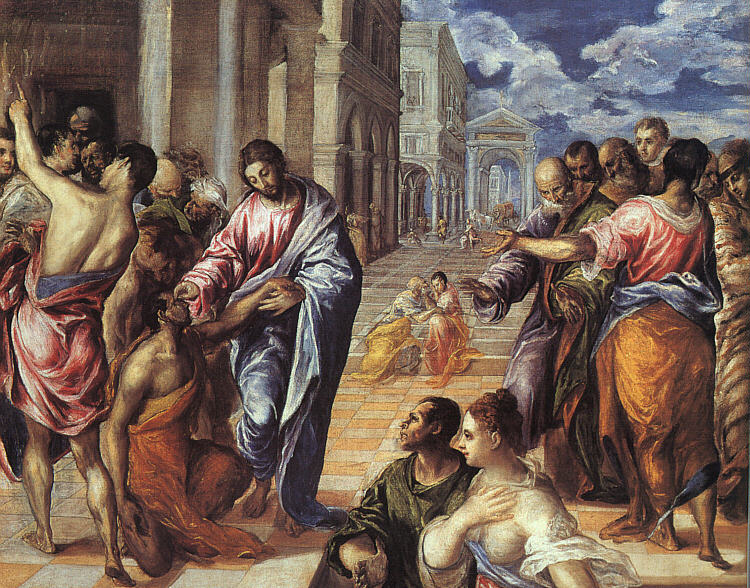
XXX SUNDAY IN ORDINARY TIME - Mark 10:46-52
This Sunday, the Gospel of Mark presents the healing of Bartimaeus, near Jericho, a southern town, near the Dead Sea. Like Jesus, he was on the road. Well, not really on the road but by the roadside. Sitting, he was begging from the passers-by a little coin or any small thing that might help him to survive. He passed his days seated by the roadside, lest he becomes a nuisance and a hindrance. He depended on the kindness of those who felt pity for him and he should not overdo it and become an occasion of stumbling for others. By the roadside, he lived as someone who hardly has the right to live as if he has been cursed. Blind, he lives in darkness, with no hope of finding the light. We may even guess that he had accepted his fate with resignation, knowing that there is no remedy for his handicap. However, one day, everything changed. He got his chance and he did not allow it to pass by but grabbed it with all his power. Hearing a strange noise of a passing crowd, he sensed that something was happening or someone very special was passing. And he asked. Once he got the answer, nobody could stop him. Full of hope, he cried out: "Jesus, Son of David, have mercy on me." 

This blind man is the paradigm of all of us who live in darkness, at the edge of the road, without knowing the way that leads us to light and life. We are blind and we cannot see the light which comes from God, giving sense and meaning to our lives. In this modern or post-modern society, our blindness to God’s presence and God’s wonderful works is becoming deeper and deeper. Full of ourselves, we remain by the roadside, unable to join the followers of Jesus. Like Bartimaeus, we need to shout: “Lord, have pity on me”. And when Jesus asks us, "What do you want me to do for you?”, we are going to reply: "Lord, let me see.” Yes, let me see the truth and feel your love. May I find salvation in you. May I find meaning and purpose for my life. May I see the way to follow you.

Saturday, 20 October 2018

THOSE IN LEADERSHIP MUST BE AT THE SERVICE OF ALL

XXIX SUNDAY IN ORDINARY TIME - Mark 10:35-45
We may think that the Church should be holy and blameless, without stains from corruption and depravation and without the power struggles which undermine her credibility. However, we should know that the Church is a source of holiness for her members, who are sinners, only because of her head, Christ, who is the redeemer and saviour. We can easily be scandalised when we see the dirty tricks used by leaders who have a grudge against other leaders in the Church or simply because they want to increase their sphere of influence.  However, this is as old as the Church, as we are told in this Sunday’s gospel. 
The two brothers, James and John, approached Jesus with a request that left all the others full of indignation, what shows that all of them had the same deep hidden desire for a position of influence and power. Throughout the history of the Church, we can find plenty of leaders - popes and bishops - who looked for power, putting on their heads the crown of royalty and imposing their will by the power of the sword, and they did all this in the name of Christ. However, by doing that, they were betraying Jesus Christ. 
The narrative of the temptations makes it very clear that Jesus rejected power as the way to establish the Kingdom of God. When he suspected that people wanted to make him king, he went into hiding. To the apostles and to us, Jesus put himself forward as an example: he did not come to be served, but to serve, and to serve to the point of giving his life for the salvation of all. 
Whenever the Church accepts power and exercises authority in the manner of the rulers of this world, it is diverting from the path that leads to salvation. In the Church, according to Jesus, authority should be exercised solely as a service, and the leaders must become the slaves of all.
Let us ask the Lord to give us a humble heart to serve. Let us pray for the pope and the bishops asking for them the humility to serve.

*****
WORLD MISSION DAY
Together with young people, let us bring the Gospel to all 
“Every man and woman is a mission; that is the reason for our life on this earth. To be attracted and to be sent are two movements that our hearts, especially when we are young, feel as interior forces of love; they hold out promise for our future and they give direction to our lives. More than anyone else, young people feel the power of life breaking in upon us and attracting us. To live out joyfully our responsibility for the world is a great challenge. I am well aware of lights and shadows of youth; when I think back to my youth and my family, I remember the strength of my hope for a better future. The fact that we are not in this world by our own choice makes us sense that there is an initiative that precedes us and makes us exist. Each one of us is called to reflect on this fact: “I am a mission on this Earth; that is the reason why I am here in this world” (Evangelii Gaudium, 273). 
We proclaim Jesus Christ 

The Church, by proclaiming what she freely received (cf. Mt 10:8; Acts 3:6), can share with you young people the way and truth which give meaning to our life on this earth. Jesus Christ, who died and rose for us, appeals to our freedom and challenges us to seek, discover and proclaim this message of truth and fulfilment. Dear young people, do not be afraid of Christ and his Church! For there we find the treasure that fills life with joy. I can tell you this from my own experience: thanks to faith, I found the sure foundation of my dreams and the strength to realize them. I have seen great suffering and poverty mar the faces of so many of our brothers and sisters. And yet, for those who stand by Jesus, evil is an incentive to ever greater love. Many men and women, and many young people, have generously sacrificed themselves, even at times to martyrdom, out of love for the Gospel and service to their brothers and sisters. From the cross of Jesus we learn the divine logic of self-sacrifice (cf. 1 Cor 1:17-25) as a proclamation of the Gospel for the life of the world (cf. Jn 3:16). To be set afire by the love of Christ is to be consumed by that fire, to grow in understanding by its light and to be warmed by its love (cf. 2 Cor 5:14). At the school of the saints, who open us to the vast horizons of God, I invite you never to stop wondering: “What would Christ do if he were in my place?” (Pope Francis, Message for the World Mission Day).