Saturday, 25 November 2017

THE LORD IS MY SHEPHERD

CHRIST THE KING OF THE UNIVERSE - Matthew 25:31-46
At the end of the liturgical year, we celebrate Christ as the King of the Universe. We speak about divine things with human language because that is the only way we can speak about anything. However, our human language can never translate God’s mystery in a perfect way, since it is always prone to confusion. And so it is the case. Jesus Christ is proclaimed king but is not a king as the earthly kings are. Calling him a king, we speak of his power, his dominion and his glory. In the first letter to the Corinthians, Paul writes that “everything is to be put under his feet”, because he will defeat all his enemies, and “the last enemy to be destroyed is death.” (1 Co 15:26-27). Jesus Christ does not wield his power and his dominion by being overbearing and by oppressing and crushing everything else. Christ presented himself as a servant, who gives up his life so that we may gain life and salvation.
When Pilate asked Jesus if he was king, he answered back that his kingdom is not of this world (Jn 18:36). Only those who search wholeheartedly for the truth will listen to his voice and accept his rule. Jesus kingship was revealed on the Cross, where he showed his love, shedding his blood for us.
The only purpose of Jesus’ kingship is that “God may be all in all.” (1 Co 15:28) If we accept Jesus Christ and live by his rule, we are led to allowing the God of love and peace be God in our lives, and then all our deepest desires will be fulfilled.
Jesus Christ is king as a Shepherd - the Good Shepherd, who cares for his people, leading them to a place of rest and peace. As a shepherd, he protects, defends, guides and heals his people. He “shows them where to rest” and he “will feed them with justice” (Ez 34:15-16)
As King of the universe, Jesus will sit on his throne to judge humankind and he will judge according to the rule of his kingdom, the love of love, mercy and compassion. 
We cannot be surprised that Pope Francis has been insisting so much on the Church being a Church of the poor, where they feel at home because they are loved and respected. If we pass by the poor, the outcast, the oppressed and the suffering, then Jesus Christ will not recognise us as belonging to his kingdom. We will be cast out and expelled from his presence.
“The Lord is my shepherd;
  there is nothing I shall want.
Fresh and green are the pastures
  where he gives me repose.
The Lord is my shepherd; there is nothing I shall want.
Near restful waters he leads me,
  to revive my drooping spirit.
He guides me along the right path;
  he is true to his name.” (Ps 23:1-3)

Friday, 17 November 2017

ARE WE LAZY SERVANTS?

XXXIII SUNDAY IN ORDINARY TIME - Matthew 25:14-30
Reading the conclusion of this Sunday’s gospel, we may get the idea that Jesus approved of capitalism. Jesus said: 
“For to everyone who has will be given more, and he will have more than enough; but from the man who has not, even what he has will be taken away.” (Mt 25:29).
Indeed, capital brings more capital, thriving in profit and increasing one’s wealth. The ones who have little easily loose the little they have, which is taken over by the one who is already rich enough. In this way, the rich become richer and the poor poorer, so that the gap between the rich and the poor becomes wider. This is a social and economic reality that find in our everyday lives, and it is not surprising that some use Jesus’ words to justify the capitalism. 
We should not misunderstand Jesus since he was not speaking about wealth; in fact, he refused to deal with issues of money (see Lk 12:13) and was very critical of those who make capital the god they worship (Lk 16:13). The parable of the talents read in this Sunday’s gospel is about the Kingdom of God and about the attitudes required to be admitted into it.
The parable speaks about a man who went on a journey and entrusted a great amount of money to three of his servants, and each one was entrusted with different responsibilities “in proportion to his ability.” (Mt 25:15). The parable helps us to understand that we are different, because of our different abilities, our different backgrounds and the different circumstances we live in. Being different, the expectations and the demands on the performance of each one of us are different as well. In spite of this difference, each one was expected to give the best of himself in commitment and in hard work. The results can be different, but they will not be the proof that one is better than the other. What is important to God, to the others and to themselves is that each must be true to himself, working wholeheartedly. All of them had to account for what they did with the talents received. Indeed, all of us are accountable for whatever we do. Life is to be taken seriously and faith implies commitment. We should never take God for granted.
Out of the three men in the parable, one was condemned as lazy and punished with exclusion from the welfare granted to the others. What was wrong with him? Out of fear, he did nothing. Knowing that his master was very demanding, he decided to hide the treasure entrusted to him, burying it and keeping it intact in order to return it to his master. He was condemned for his lack of vision and initiative. He was not prepared for adventure and he would not take risks. In the end, fear was just an excuse for his laziness.

Like the other two servants, we must be ready to use whatever the Lord has given us to invest and bring development to ourselves and the others.

Friday, 10 November 2017

BE PREPARED FOR THE COMING OF THE LORD

XXXII SUNDAY IN ORDINARY TIME - Matthew 25:1-13
The first reading (Wisdom 6:12-16) speaks about wisdom and how she comes to all those who look for her. Indeed, we are in need of wisdom to find meaning in our lives and to establish bonds of friendship and solidarity with others in the community. Without wisdom, we are not able to see our own limitations and to recognise the contributions of others to our own welfare. It is wisdom that helps us to recognise the presence of God in the world around us, mainly in the faces and the lives of the people we live with. Only wisdom can set us walking in a straight path, the path to justice and peace. 
A Bemba proverb tells us: Amano uli weka: tayashingauke koshi (Alone your wisdom: does not go around your neck) and another one says: Amano mambuulwa (wisdom, the things that you pick up, learning from others). True wisdom cannot thrive in loneliness, much less in selfishness; instead, it learns from and with the others, making communion and peace possible. True wisdom is God himself guiding us through the path of life.
In the gospel, we find the parable the ten virgins who went to welcome the bridegroom for his wedding feast. The theme of a bridegroom and his wedding feast appears several times in the New Testament (for instance, Rev 21:2,9). Christ is the Bridegroom; he will come at the end of times and then his beloved bride, the Church, will be presented to him. The bridesmaids represent all of us. Like them, we wait for his coming. When is he coming? We do not know. We just wait and wait and the delay seems to be too prolonged, so that we may get tired of waiting. 
The ten virgins fell asleep, all of them and someone had to wake them up. Like them, we may go through moments of tiredness and sleepiness or times of disappointment and darkness. We may think that we are waiting in vain and that, in the end, nobody is coming and we will realise that our wait was wasted time. However, the parable tells us that Christ is coming; and at his coming, there will be a great celebration, full of joy and happiness. Will we be there and have a share in that feast?
According to the parable, there were two kinds of virgins, the wise and the foolish. Some prepared themselves for the delay, while others did not think of such a possibility. They were not prepared for hard times when the Lord seems to be absent and we see ourselves as abandoned and lost. So, when they heard the announcement of the bridegroom’s arrival, they had to go out into the darkness of the night to buy oil for their lamps. When they came back, the feast had begun and the door was closed. They were late. To enter the banquet hall, one must be ready and well prepared. The Bemba proverb says Umuti uwila uko wakongamina (the tree falls to where is bent). If we are turned to Christ, then we will fall to Christ.

Let us ask the Lord the grace of being prepared for his coming.

Saturday, 4 November 2017

WHO ARE OUR ROLE MODELS?

XXXI SUNDAY IN ORDINARY TIME - Matthew 23:1-12
Speaking to his disciples and to the public in general, Jesus warned them about the Pharisees and the Scribes. They were in a position of leadership. By saying that they “occupy the chair of Moses”, Jesus implies a certain usurpation. Indeed, they were not the traditional leaders of the people and may say that they were self-appointed leaders, who put themselves in front of the people and sometimes over them. Why did Jesus warn against them? They presented themselves as role models for the people, but they were fake role models, claiming an authority that they did not have and demanding that people imitate them. 
They do not practice what they preach. They deceive people because they themselves do not believe in what they preach.
 They are hard and extremely demanding on the others, but easily find excuses for themselves. “They tie up heavy burdens and lay them on men’s shoulders, but will they lift a finger to move them? Not they!” (Mt 23:4).
Finally, Jesus accuses them of doing everything to attract attention. They would like to be ranked among the best for their names to appear in the Hall of Fame. They want to be recognised and honoured, they must make it to the top.
We should ask if similar attitudes are not found in the Church among our leaders and among ourselves. Do we live according to what we teach to the others? Are we not ready to condemn the others, finding fault with everything they do, while we do not apply the same rules to us? Are we ready to serve, or do we look for fame, presenting ourselves as the best, and demanding applause from the others?
We may ask as well: who are our role models? Who are the ones who influence us and whom we are ready to listen to? And, if we are in a position of leadership, can we serve of role models to the others? Are we true to ourselves, living by what we teach?
In the first reading, the prophet Malachi denounces the priests and their teaching to the people: “… you, you have strayed from the way; you have caused many to stumble by your teaching. You have destroyed the covenant of Levi, says the Lord of Hosts.” (Mal 2:8).

Let us pray for all those who are in positions of leadership, so that they may be true role models for the people that they serve.

Saturday, 28 October 2017

THERE IS ONLY ONE COMMANDMENT, THE COMMANDMENT OF LOVE

XXX SUNDAY IN ORDINARY TIME - Matthew 22:34-40
During Jesus’ time, the group of the Pharisees had already a big influence over the people and that influence would grow stronger after the destruction of Jerusalem. With their single-mindedness about the Law, they managed to achieve the survival of the Jewish people and find a new way to keep alive the faith in Yahweh (the Lord), without the temple and without priests. Their ideals and their attitudes were very different from the ones of the Sadducees, who were traditionalists in questions of religion and collaborationists in political matters. The Pharisees were radicals and fundamentalists, being very strict in all matters concerning the Law. And that’s where they entered into conflict with Jesus, even though, in their ideals, they were the closest to Jesus. However, Jesus could not accept their strict legalism, which did not allow them to take into account the suffering of the common people. Confronted with Jesus who was led by the freedom of the Spirit, they saw in him an enemy and joined the Sadducees to get rid of Jesus.
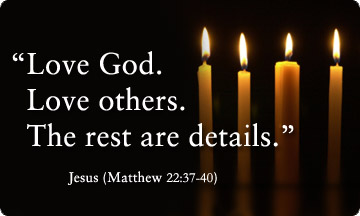
Trying to put Jesus to the test, they approached and asked him a question: Which is the greatest commandment in the Law? And Jesus put forward a straight answer: There are only two commandments: the first and most important is to “love the Lord your God with all your heart, and with all your soul, and with all your mind.” And the second is “You shall love your neighbour as yourself.” In the end, there is only one commandment - the commandment of love, in which the love of God and the love of our neighbour go together. It is a fallacy to think that we may love God while ignoring the others with whom we live. How can we love God, if we do not recognise his image in the lives of our neighbours? How can we call God Father, when we do not accept the others as brothers and sisters?
In a way, it is very easy to be a Christian. We do not have plenty of rules and norms like the Jewish People. We have only one commandment, the commandment of love. And we will be judged by that commandment.
Nowadays, the word love is easily misunderstood with passion, pleasure and lust, which lead only to self-indulgence, which is selfishness, that is the opposite of love. True love leads us to pay attention to the needs of the others and gives us the strength to suffer for the benefit of the others.

In the first reading, taken from the book of Exodus, we are told how to behave towards all those who are in need of being supported and protected. In the Exodus, God points out three concrete situations in which are called to show love to the ones who suffer: the alien (the stranger), the orphan and the widow and the poor who borrowed money.
God reminds the people of the times when they experienced suffering and oppression because one they lived in foreign land and were treated as slaves, They are advised to do not the same to the foreigner living among them
Nowadays, there are plenty of people living far away from their homeland. Some emigrated in search of work and of a better life and they are ready to go through unthinkable trials in order to achieve that. Others are refugees who run away from persecution and war. They are welcomed in very few countries; they spend months (years) in refugee camps and are treated harshly. The first reading is a clear warning for all those who refuse to see in the alien - the emigrant and the refugee - a fellow human being, a child of God like them: one day, they will go through the same painful experience.
The orphan and the widow stand for all those who experience the loneliness and the struggle for survival. They need to be protected and defended. They need that we make ourselves their neighbours. We may remember the drug addicts or those who suffer from incurable diseases. They cannot be abandoned to themselves but need our compassion and our care.
Finally, the passage (Ex 22:25) deals with the money lenders, telling them that they should not demand interest; instead they must pay attention to the plight of the poor and God will listen to the cry of the poor.
How different is our society today, where high interest is demanded from all those in need, be it individuals or countries. The lending of money has become a big business, aiming at the highest possible profit. In the end, the money lending becomes a form of exploitation, forcing the poor into an abject situation, while the rich become ever richer.
Let us learn with Jesus to allow our hearts to be touched by the pain of others and to be compassionate with all those who suffer.

Friday, 20 October 2017

LOVED AND CHOSEN

XXIX SUNDAY IN ORDINARY TIME - 1 Thessalonians 1:1-5
With a thankful heart, Paul remembers his mission among the Thessalonians, praying for them. He gives thanks to God because they showed their “faith in action worked for love and persevered through hope”. (1 Th 1:3).
This passage brings to mind my own experience, mainly in Lubengele, Chililabombwe. I found so many people profoundly committed, strong in their faith and living guided and supported by hope, the hope that they find in Jesus Christ. They accepted me as one of their, confiding in me and entrusting me with their joys and their sorrows. We walked together in faith, having Jesus as our way.
Speaking to the Thessalonians, Paul told them: “We know, brothers, that God loves you and that you have been chosen”. (1 Th 1:4) These words apply to all of us: We know that God loves and that we have been chosen. And we cannot keep silent about it. This is a good news that we cannot keep for ourselves. It is a secret that we cannot keep, that we have to broadcast far and wide. This love that we receive from God impels us to share it so that others mays experience the same love. 

In the Catholic Church, this Sunday is called the Mission Sunday or the World Mission Day. For this year, Pope Francis put forward the following theme: “Mission at the heart of the Christian faith”. To be a missionary is a must because we believe. Once we have experienced being loved and being chosen, we become witnesses of that love and we are always ready to explain the reasons of our believe and to announce to all far and near that Jesus is the Saviour, that he is the way, the truth and the life (Jn 14:6).

The faith in Jesus Christ is not something that we can hide. How can we hide the fact that we live guided by faith, “rooted and built up in him (Jesus Christ)”? (Col 2:6) Without being missionary, the Church “would no longer be the Church of Christ, but one group among many others that soon end up serving their purpose and passing away.” (Pope Francis). “The Church’s mission, then, is not to spread a religious ideology, much less to propose a lofty ethical teaching.” (Pope Francis). The Church’s mission is to lead people to Christ and to facilitate their encounter with him, so that they may feel loved and chosen.

Friday, 13 October 2017

THE WEDDING ROBE

XXVIII SUNDAY IN ORDINARY TIME - Matthew 22:1-14
The parable of the wedding banquet of the king’s son is very revealing. Salvation is presented as a feast, a wedding feast and a banquet is always part of a big feast, mainly a wedding feast.
In Isaiah, God had promised to prepare for all peoples a great banquet with the best foods and best wines. Everybody will rejoice, because “the Lord will wipe away the tears from every cheek; he will take away his people’s shame everywhere on earth”. “He will destroy Death for ever”, and all lips will sing songs of victory (Is 25:6-10)
In the book of Revelation, myriads of people will gather for the marriage of the Lamb (Rev 19:6-7) and rejoice singing God’s praises.
The parable of the wedding banquet makes as well an interpretation of the history of salvation. There was a first group invited to the banquet who refused to take part in the banquet, presenting all kinds of excuses, even senseless excuses. Presenting a refusal without any valid reason, the parable is an indictment of those who rejected the invitation and it is not difficult to understand that they stand for the people of Israel. That’s why those with a standing among the people tried to entrap and catch him (Mt 22:15)
Presented with the rejection of those who had been invited, the king decided to open the palace’s gates and to call everybody to the banquet. So the “servants went out on to the roads and collected together everyone they could find, bad and good alike; and the wedding hall was filled with guests.” (Mt 22:10). We may think that the king took this action out of frustration with the behaviour of those who had shown to be unworthy of his invitation. However, as we can find in the first reading, from the beginning God had a plan of universal salvation and the people of Israel were chosen and set apart to facilitate the fulfilment of that plan. With their unfaithfulness, it was as if they had become an obstacle to that plan. The parable shows clearly that the revolt of the people of Israel cannot stop God’s plan from being fulfilled.
The parable ends with a saying that sounds strange: “For many are called, but few are chosen.” (Mt 22:14). It is strange because the parable shows a different reality: of those called all but one were accepted; all but one entered the kingdom hall and sat at the table of the Lord. They were called in the streets, unexpectedly, without much time to prepare themselves. Maybe, they were already prepared. In Bemba, the proverb says: Uwaitwa, tafwala bwino. Once called, we must not delay. We must ready to answer the call, God’s call.
In that big crowd, there was one who should not be there and he was asked: “How did you get in here, my friend, without a wedding garment?” And he was thrown out into the dark. 
What was that wedding garment? The parable does not say. However, in his letters, speaks several times of what should wear: 
“put on the Lord Jesus Christ” (Ro 13:14); 
“put on the breastplate of faith and love” (1 Tea 5:8);
“Put on the whole armour of God” (Ep 6:11)
The conclusion of the parable - “For many are called, but few are chosen.” - comes as a warning for us to be faithful, so that we may sit at the Lord’s table and rejoice in his presence