Saturday, 26 June 2021

YOU HAVE RESTORED ME TO LIFE

XIII SUNDAY IN ORDINARY TIME - Mark 5:21-43

This Sunday’s gospel gives us a passage of Mark, in which he puts together two episodes that bring forth our fragility and mortality. We may become delusional with dreams of total victory over sickness and death. We have lived as if nothing is impossible to science, being sure that it will find soon a remedy for all sicknesses. However, the covid-19 pandemic has shuttered those false hopes. And the science we trust may be the same one that caused the pandemic. It is as if we were lost, suffering the consequences of a curse. We may remember the words of the prophet Jeremiah: 

“Cursed is the man who trusts in man

and makes flesh his strength,

whose heart turns away from the Lord.” (Jr 17,5). 

Faced with suffering and death, we may point to God, accusing him of being the source of all evil that we suffer. Why are we mortal? And if that is our fate, why do we have a profound desire for everlasting life? Why do we feel the pain of death and refuse to resign ourselves to it? These are difficult questions, which we go on asking, even though we do not find answers beyond those already found.

The book of Wisdom, reflecting on life and death, gives a clear answer:

“Death was not God’s doing,

he takes no pleasure in the extinction of the living.” (Wis 1:13).

And then it adds:

“It was the devil’s envy that brought death into the world,

as those who are his partners will discover.” (Wis 2:24).


In the gospel, Jesus shows God’s compassion towards those who suffer. He is on the side of all those who feel trapped in the limitations of this earthly life. The woman “who had suffered from a haemorrhage for twelve years” lived a hopeless life, as if she was already dead. Due to her condition, she would not have children, thus being considered cursed and impure. The girl who was twelve years old died in the prime of life, without being able to assume responsibility for her life or contribute to the wellbeing of her people. It is as if she had not lived. In such situations, we lose hope and everything becomes meaningless. Then, we must turn to Jesus and approach him with confidence. He is “the resurrection and the life” (Jn 11:25). Only with him we can overcome death and pass through the gate to eternal life.

We may sing with the psalmist:

“I will praise you, Lord, you have rescued me

  and have not let my enemies rejoice over me.

O Lord, you have raised my soul from the dead,

  restored me to life from those who sink into the grave.” (Psalm 30).

Saturday, 19 June 2021

LORD JESUS, SAVE US

XII SUNDAY IN ORDINARY TIME - Mark 4:35-41

At the end of the day, with his disciples, Jesus crosses the lake “to the other side”, that is to the territory of Decapolis, which was already outside the land of Palestine, thus being pagan land. This symbolises the move of the Church towards foreign land to proclaim the Good News to the Gentiles (all those who were not Jews). This move was not an easy one. It was more like a dangerous adventure.


The crossing of the lake had everything to make it terrifying: the darkness of the night, the heavy and strong winds and the waves tossing the boat in all directions and spilling water all over as if they were going to engulf it. Jesus was with them. However, while the disciples struggled with the waves and tried to steer it to safety, Jesus slept, unconcerned, as if he was not there. It is the same with the Church. Many times, when she sails through rough waters, we have the feeling that the Lord Jesus Christ is absent, but he is with us. He has entrusted the work to us and he is with us, always ready to hear our cry for deliverance. Whenever we feel in danger, we can approach him and repeat the words pronounced by the apostles: “Master, do you not care? We are going down!” Jesus reproached them for their lack of faith, but he used all his power to bring everything under control so that the disciples could find rest and peace.

In the second reading (2 Corinthians 5:14-17), we hear Paul telling the Corinthians that Jesus’ love is overwhelming. He died for all of us so that in him we might be alive for God. We should be dead to the world, “so that living men should live no longer for themselves, but for him who died and was raised to life for them.” In Christ, we have become “a new creation”, as the glory of God become more and more manifest in our lives.

“Some sailed to the sea in ships

  to trade on the mighty waters.

These men have seen the Lord’s deeds,

  the wonders he does in the deep.


For he spoke; he summoned the gale,

  tossing the waves of the sea

up to heaven and back into the deep;

  their souls melted away in their distress.


Then they cried to the Lord in their need

  and he rescued them from their distress.

He stilled the storm to a whisper:

  all the waves of the sea were hushed.”

Psalm 107

Saturday, 12 June 2021

INTENT ON PLEASING HIM

XI SUNDAY IN ORDINARY TIME - 2 Corinthians 5:6-10

Paul looks at human life here on earth and considers it to be living in exile. We don’t belong here; however, while we are here, we proceed forward with confidence. We are not alone in this journey, since we are in the hands of the Lord (Ro 14:8). As we move ever closer to our final destination, we must have only one concern: “We are intent on pleasing him”. To please the Lord, we must lead a way of life that is detached from this transient world. As we live in exile, we walk guided “by faith and not by sight” and this faith fills us with confidence.

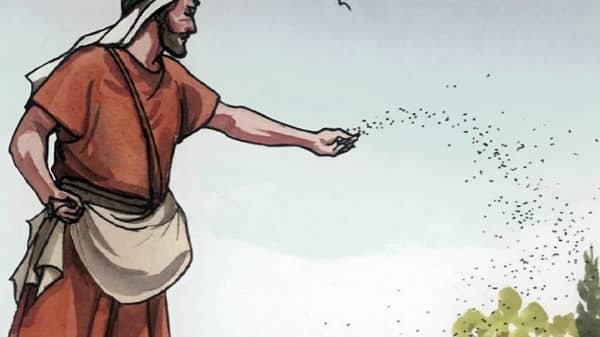
The Lord has sown in us the seed of eternal life and salvation. Even though small, the seed germinates and grows until it will reach maturity and give fruits. Because we may not see immediate results, we may be filled with misgivings. However, we are not walking in vain. The Lord will make sure that his seed will produce good and plentiful fruits. The Kingdom of God is like a man who “throws seed on the land. Night and day, while he sleeps, when he is awake, the seed is sprouting and growing; how, he does not know. Of its own accord the land produces first the shoot, then the ear, then the full grain in the ear. And when the crop is ready, he loses no time: he starts to reap because the harvest has come.” (Mk 4:26-29).


When the time comes, we will be subjected to judgement: “For all the truth about us will be brought out in the law court of Christ, and each of us will get what he deserves for the things he did in the body, good or bad.” (2 Cor 5:10). While we live in this world, let us pay attention to Paul’s advice:

“Do not be conformed to this world, but be transformed by the renewal of your mind, that by testing you may discern what is the will of God, what is good and acceptable and perfect.” (Ro 12:2).

Saturday, 5 June 2021

THIS IS MY BODY; THIS IS MY BLOOD

THE SOLEMNITY OF CORPUS CHRISTI - Mark 14:12-16,22-26


The Church has dedicated this solemnity to celebrate the Eucharist, putting the stress on the bread of life that is the body of Christ. We may ask ourselves why, since we celebrate the Eucharist every day and in a special way every Sunday. As humans, we lose easily the sharpness of our senses and become dull and mindless in what we do. This feast was established to help us strengthen our faith and remind us of the essential aspects of the Eucharist. Thursday is the day of the Eucharist since Jesus ate the Last Supper on a Thursday evening. Thus the solemnity of Corpus Christi is supposed to be celebrated on the Thursday following the Sunday of the Holy Trinity. However, in the countries where that Thursday is not a holiday, the feast is transferred to the following Sunday.

We call the Eucharist the Most Blessed Sacrament because in it we celebrate the great mysteries of our salvation, mainly the passion, death and resurrection of Jesus Christ. In this Most Blessed Sacrament, we enter in communion with Jesus Christ to become with him one body. And being one with Him, we become children of God. The celebration of this solemnity helps us not to lose sight of the body and blood of Christ, who offered Himself as the sacrifice that seals the New Covenant. We are people of the New Covenant, who have been reconciled with God through Jesus’ passion and death: “his death took place to cancel the sins that infringed the earlier covenant.” (Hb 9:15).

In the Last Supper, Jesus gave the meaning and purpose of his death: “This is my blood, the blood of the covenant, which is to be poured out for many.” (Mk 14:24). He brought about the New Covenant and in it, he offers himself in sacrifice. He is the High Priest and at the same time the sacrifice without blemish which is acceptable to God. As we celebrate the Most Blessed Sacrament, we are called to offer the Sacrifice of the New Covenant, the perfect sacrifice, the sacrifice of the People of God, in which we offer ourselves with Jesus. 

In this Solemnity of the Body of Christ, we are called to the faith that the bread we eat is the body of Christ and the cup of blessing from which we drink is a share in the blood of Christ. We believe it and that belief we keep the faith of the Church, expressed since the beginning in writings of the Fathers of the Church. In his first Apology, Saint Justin wrote:

“And this food is called among us Eucharistia [the Eucharist], of which no one is allowed to partake but the man who believes that the things which we teach are true, and who has been washed with the washing that is for the remission of sins, and unto regeneration, and who is so living as Christ has enjoined.

For not as common bread and common drink do we receive these; but in like manner as Jesus Christ our Saviour, having been made flesh by the Word of God, had both flesh and blood for our salvation, so likewise have we been taught that the food which is blessed by the prayer of His word, and from which our blood and flesh by transmutation are nourished, is the flesh and blood of that Jesus who was made flesh.” – (First Apology, 66)


Saturday, 29 May 2021

GOD IS COMMUNITY, GOD IS LOVE

THE SOLEMNITY OF THE HOLY TRINITY - Deuteronomy 4:32-34,39-40

The first reading, taken from Deuteronomy, makes it very clear: there is only one God - “YHWH (Lord) is God in heaven above and on the earth beneath; there is no other.” (Dt 4:39). As Christians, we inherited this belief from the people of Israel. Like them, we believe that there is no other God, but Yahweh. Together with the Jews and the Christians, the Muslims believe as well in one God, thus being considered monotheistic religions, called also Abrahamic because they follow the footsteps of Abraham who believed in one God.

Professing a very strict monotheism (tawhid), the Muslims accuse the Christians of shirk, the unforgivable sin of believing in several gods or of associating others with God. The Christian belief in the Holy Trinity is misunderstood as a belief in three Gods: the Father, Jesus and Mary. 

“O Jesus son of Mary, did you say to the people, `Take me and my mother as gods rather than God?’” (Quran 5,116).

Christians never believed that Mary, the mother of Jesus, is a goddess. In the Creed, proclaimed every Sunday during the liturgical celebration, we say: “I believe in one God”. In the strict monotheism of Islam, Allah is a lonely God, incapable of a personal relationship with human beings. He is the Almighty, the All-knowing and everything must submit to him. Islam is total and complete submission to God and his Messenger. The only possible relation is that one of the Master with the slave. Even though presenting himself as the Almighty  God, Yahweh put his power and his knowledge at the service of his love. Since the beginning, the Holy Scriptures present Yahweh as a God who affirms his divinity by establishing a relationship with humanity and then, for the sake of humanity, with the people of Israel. God sealed this relationship with a covenant, through which he commits himself the be our companion in our journey through this world. Little by little, in the history of salvation, we see the mystery of God unfolding before us - He never gets tired of establishing a relationship with humanity because in himself he is relationship. The belief in the Holy Trinity expresses that: God is a community. Within God, there is communion, because God is love. Being love, God is self-giving, bestowing his love and mercy upon the ones he loves.


In the letter to the Romans (second reading), Paul speaks of the relationship of love which God establishes with us by pouring his Spirit upon us, thus adopting us as his children.

“The spirit you received is not the spirit of slaves bringing fear into your lives again; it is the spirit of sons, and it makes us cry out, ‘Abba, Father!’” (Ro 8:15).

We are not slaves, but children - the beloved children of God. In baptism, we were born again by the power of God to be destined to become “heirs of God and co-heirs with Christ” (Ro 8:17). That’s why we can approach him with confidence and hope. He will not turn his back on us. He will not go back on his word. He will never desert us unless we reject him and turn our backs on him.

We are called to be witnesses of God’s love and we are given the mission of announcing to the nations that in Jesus Christ we find salvation.

“Go, therefore, make disciples of all the nations; baptise them in the name of the Father and of the Son and of the Holy Spirit, and teach them to observe all the commands I gave you.” (Mt 28:19-20).

Saturday, 22 May 2021

IN THE ONE SPIRIT WE WERE ALL BAPTISED

THE SOLEMNITY OF PENTECOST - Acts 2:1-11

Pentecost was a Jewish feast celebrated fifty days after the great feast of Passover. It was the feast in which the Covenant, the receiving of the Law and the setting up of the People of God were celebrated. In the Acts of the Apostles, Luke gives a new meaning to the feast. Thus, in Pentecost, we celebrate the new covenant and the new people of God, filled with the Holy Spirit who grafts them in Christ, thus becoming one body in Christ.


The liturgical readings of this solemnity make it clear that the Church is different from any other human organisation, set up by a group of individuals with human goals and rules. The Church belongs to Christ. He is the head and the centre of the Church. There is no other reason for the Church’s existence, but Christ. Upon the Church, Christ sent the Holy Spirit to “renew the face of the earth.” As at the beginning of creation (Gn 1:2), the Spirit comes upon humankind as a mighty wind to breathe new life and a new purpose - for the glory of God to be present and active in the life of his people.

The Holy Spirit comes down on the disciples as God’s burning fire (the bush) which does not consume and destroy but purifies and sets up a people strengthened and united by the fire of love, the only commandment that we must carry out faithfully.

The first chapters of the book of Genesis present humanity going astray and moving further and further away from God. Human beings have their own project for society, and that project ends up destroying harmony and peace and setting up division. In the book of Genesis, the story of the tower of Babel (Gn 11) is used as a symbol of humanity separated from and in conflict with God. The Pentecost celebrates a new creation, called to live in harmony and peace, but upon a diversity of tongues, tribes and nations. The Gospel is a universal message that is to be preached to all peoples of the earth and in all languages. Despite all the diversity of races, tribes and nations, all are called to be one.

However, this new people of God can only become a reality when recognising our sinfulness, we accept being redeemed and saved. The new people of God is a reconciled people, entrusted with the ministry of reconciliation. In the Gospel of John, Jesus breathes the Spirit upon his disciples, as he entrusts them with his mission and with the ministry of reconciliation.

According to Paul in his First Letter to the Corinthians, we are led to Jesus by the Holy Spirit, who makes it possible for us to proclaim that “Jesus is Lord” (1 Cor 12:3). We were all baptised in the Holy Spirit so that we become one. The differences among us should not create division but should be put at the service of others so that everybody grows to maturity in Christ.

Saturday, 15 May 2021

GOD MADE HIM THE RULER OF EVERYTHING

THE ASCENSION OF THE LORD - Acts 1:1-11


The solemnity of the Ascension celebrates Jesus being “lifted up” or “taken up into heaven” (Mk 16:19). We may ask ourselves about the meaning of such language.  Certainly, it has nothing to do with physical lifting. Jesus’ ascension into heaven is not a rocket launching.  In his letter to the Ephesians, Paul speaks of the glorification of Jesus Christ, who seats at the right hand of the Father and is made Lord and ruler of everything (Ep 1:22). Jesus’ ascension is a source of hope for all those who have become his followers. With his ascension, humanity has been glorified and is seating at the right hand of God. If we become one body with him, then we will share in Jesus’ glory.

In the first reading, taken from the Acts of the Apostles, we can find Jesus’ promise of the Holy Spirit and the mission entrusted to the disciples: they must be witnesses of Jesus “to the ends of the earth.” In the gospel of Mark, we find the confirmation that the disciples carried out the mission entrusted to them: “they, going out, preached everywhere” (Mk 16:20). However, up to the end, the disciples kept steadfast in their hope that Jesus would establish an earthly kingdom in which they would enjoy wealth and power. Wealth and power are like drugs to which we become addicted. Throughout the ages, people have been ready to sacrifice everything in order to obtain both wealth and power, considered as of supreme value. Jesus made it clear that they were wasting their time because an earthly kingdom was not part of his mission. That was in the hands of the Father.

At the end of the passage, as “a cloud took him from their sight”, the disciples remained there “looking into the sky”, as if in ecstasy. And they had to be called back to their senses and reality.  

The disciples are continuously faced with two big dangers: a) to be seduced by wealth and power; b) to be allured by the heavens and forget the world we live in. We do not belong to the world, but we live in the world and are called to be witnesses of Jesus Christ in this world where we live. We must not forget that, here on earth, we are pilgrims. Our hearts hope for the glory of Christ, while at the same time leading us to walk in the way of Christ.